
Rising AI Subscription Costs Make Tool Choice More Important
For a while, the default posture around AI tooling was simple: pay for the best plan you can justify, point the strongest model at everything, and move fast.
That posture is getting more expensive.
Recent pricing changes and usage-based pricing models make it harder to treat every task like it deserves the most expensive possible model. GitHub Copilot's pricing documentation now makes token-level tradeoffs much more explicit, and Anthropic users have also been feeling plan pressure. As George Pu summarized in this post on X:
Anthropic just pulled Claude Code from the Pro plan. Pro users wanting it need Max now.
$100/month minimum. 5x jump.
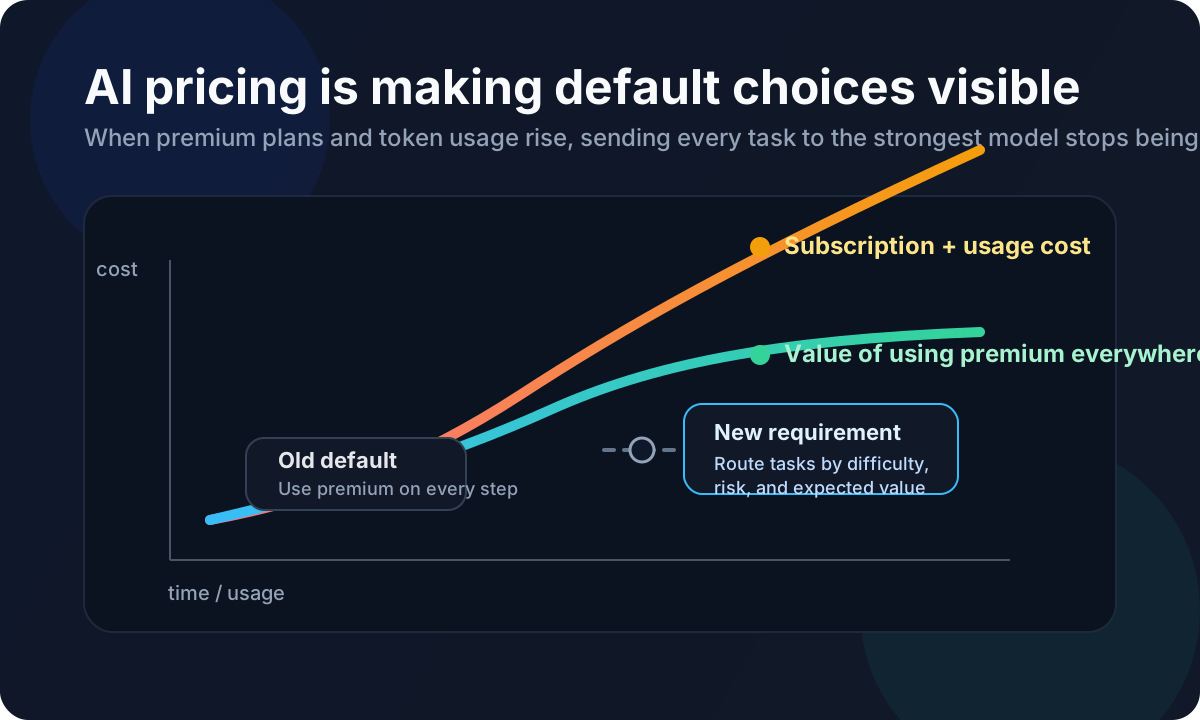
Whether the exact pressure shows up as a higher subscription tier, stricter usage caps, or token-based overages, the direction is the same: waste is becoming visible.
The real problem is not just price
The problem is not that strong models cost money. The problem is that many teams still use them with a flat strategy.
That usually looks like this:
- use the same premium model for brainstorming, rote edits, search, summarization, and difficult reasoning
- send large context windows even when the task is narrow
- let every workflow behave as if accuracy needs are identical
- treat convenience as if it were efficiency
That can feel fine when the marginal cost is hidden. It feels very different once the bill starts reflecting every token, every long context window, and every premium model multiplier.
The new constraint is judgment
As pricing becomes more granular, the winning teams are not just the teams with access to the best model.
They are the teams that can answer a more operational question:
What is the cheapest reliable way to complete this specific task well?
That is a routing question as much as a model question.
Sometimes the right answer is a top-tier reasoning model. Sometimes it is a fast cheaper model. Sometimes it is not a model-heavy step at all, but better prompting, retrieval, a narrower tool call, or a plugin that breaks the work into smaller pieces.
Not every task deserves the same model
The mistake is assuming that all AI-assisted work is “coding,” “writing,” or “analysis” in one undifferentiated bucket.
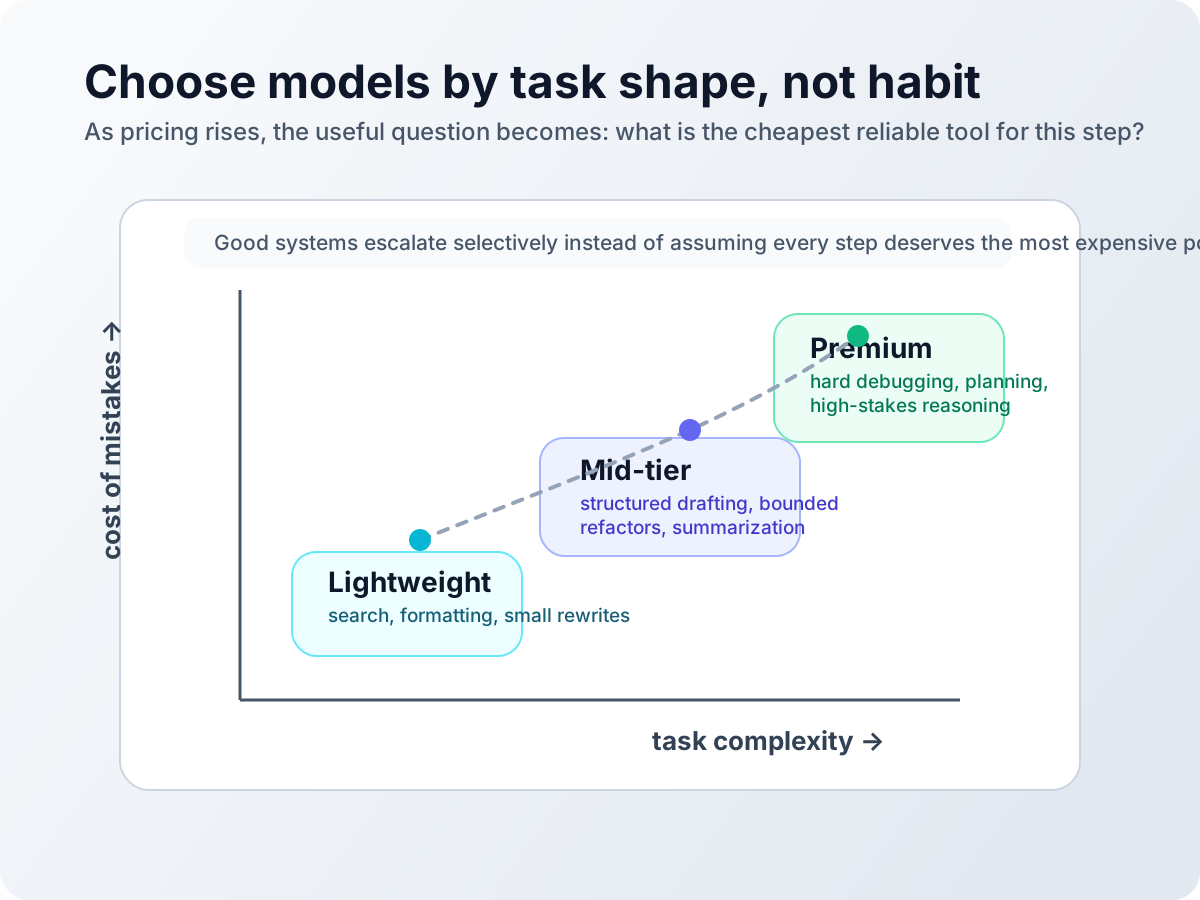
In practice, workflows contain very different task shapes:
High-value tasks
- architectural tradeoff analysis
- debugging ambiguous failures
- multi-step planning
- complex code generation with many constraints
- final-pass review where mistakes are expensive
These often justify a stronger and slower model because the cost of being wrong is high.
Medium-value tasks
- refactoring with clear boundaries
- summarizing docs or PRs
- converting notes into structured output
- first-pass test generation
These may benefit from a mid-tier model, especially when the task is still somewhat open-ended but not highly novel.
Commodity tasks
- formatting or rewriting small sections
- generating commit messages
- searching for likely file locations
- extracting a few facts from known context
- transforming one structured format into another
These are often where teams quietly burn budget by using their most expensive model by default.
Pricing changes make lazy defaults expensive
GitHub Copilot's current pricing docs are a useful example because they make the mechanics hard to ignore.
- model choice affects token cost
- input, cached input, and output can all price differently
- some workflows introduce additional operational costs beyond the model itself
- plan allowances and multipliers change over time
Once pricing works like that, “just use the best model” stops being a strategy. It becomes a budgeting leak.
The same lesson applies beyond Copilot. If premium capabilities move behind higher tiers, or if previously bundled workflows become metered separately, teams have to become more intentional about where expensive intelligence is actually buying them something.
This is where plugins and orchestration layers help
The point is not that every team needs one specific product.
The point is that tooling that helps route work intelligently is becoming more valuable.
That can take several forms:
- IDE plugins that steer different actions to different models
- coding assistants that separate autocomplete from deeper reasoning
- workflow tools that keep cheap steps cheap and reserve expensive models for hard decisions
- orchestration layers that split one large prompt into smaller, more targeted operations
Weave is one example of that kind of approach, not the whole category.
The broader idea matters more than the specific product: if your tooling can distinguish between search, planning, transformation, review, and execution, you have a chance to align cost with task complexity instead of paying premium rates for everything.
Better routing improves more than cost
The hidden benefit is that cost-aware routing often improves quality too.
Why?
Because once you start asking which tool should handle which step, you also start making the workflow clearer.
You reduce oversized prompts. You break vague requests into explicit subproblems. You stop treating one giant model call as the only interface for getting work done.
That usually leads to:
- more predictable outputs
- lower latency on simple steps
- easier debugging when a workflow fails
- clearer escalation paths for the tasks that truly need heavy reasoning
In other words, the same discipline that saves money also tends to produce more legible systems.
A practical way to think about it
If AI spend is going up, a useful rule of thumb is this:
- Use the lightest tool that can do the job well.
- Escalate only when the task actually needs stronger reasoning.
- Break large tasks into smaller task types when possible.
- Use plugins or workflow layers that make those distinctions easier to enforce.
That is not anti-model. It is pro-efficiency.
It also reflects where the market seems to be heading. As vendors expose more granular pricing and reserve more premium capability for higher tiers, the teams with the best outcomes will likely be the teams with the best routing discipline.
Closing thought
Rising subscription prices are not just a billing story. They are a workflow design story.
If premium AI becomes more expensive, then picking the right model for the right task is no longer an optimization for power users. It becomes part of normal engineering hygiene.
And that is exactly why lightweight plugins, model routers, and orchestration tools are becoming more important: not because they replace good models, but because they help teams use good models more deliberately.